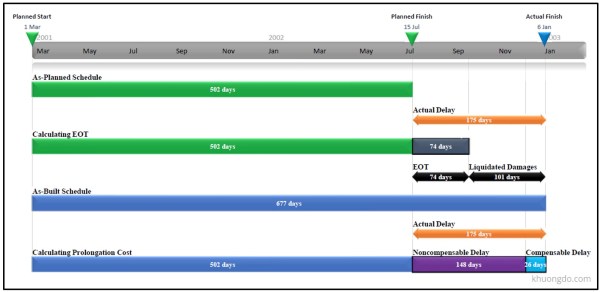
Purpose of EOT It is often incorrectly thought that entitlement to an EOT automatically carries with it an entitlement to compensation for prolongation costs during the period of the EOT. The main effect of an EOT is that the Contractor is relieved of its liability for liquidated damages during the period of the extension and... Continue Reading →
Delay Start-up Insurance to cover Anticipated Profit, Revenue in a Delayed Project
1. What is Delay Start-up Insurance (DSU)? Delay in start-up (DSU) cover is designed to secure the portion of revenue which the owner: Requires to service debt; and Realize anticipated profit. It provides protection against delays arising from physical damage caused by any type of peril included in the relevant material damage cover, i.e. the... Continue Reading →
Basic Concepts and Principles of Construction Claims
1. Introduction 1.1. Construction Claims What is Construction Claims? A construction claim is the assertion of a right demanding either additional time or/and payment due to the result of an action. It is possible to meet construction claims in all construction projects. Why do Construction Claims occur? Clients, contractors, and subcontractors of this environment try... Continue Reading →
Concurrent Delay and Pacing Delay in Construction Claims
What is Concurrent Delay in Construction Claims? Meaning of concurrent delay (from SCL Delay and Disruption Protocol 2nd Edition) True concurrent delay is the occurrence of two or more delay events at the same time, one an Employer Risk Event, the other a Contractor Risk Event, and the effects of which are felt at the... Continue Reading →
Typical Delay Analysis Methods in Construction Claims
This article addresses the concepts of several typical delay analysis methods in construction claims. Why do we need Delay Analysis in Construction Claims? Because The Delay Must Affect The Critical Path The Construction Contracts often state that no adjustment to the critical milestones dates or the scheduled completion dates would be made unless the delay... Continue Reading →
Concurrent Delay and Pacing Delay in Construction Project
What is Concurrent Delay? The term “concurrent delay” is commonly used to describe circumstances where owner-caused delays and contractor-caused delays occur at the same time. In true concurrency, the owner and contractor delay events (the cause of delay) both occur at the same time and the delay caused by the delay events start and finish... Continue Reading →
Forensic / Delay Schedule Analysis – Summary Graphic Report in 1 Page
After completing delay analysis in Primavera P6 or MS Project, it is important to prepare a concise summary graphic report tailored for high-level management. Detailed reports, such as the one shown below, can be overwhelming and make it difficult to grasp the overall impact of delays at a glance. A simplified visual—such as a bar... Continue Reading →
How to perform Collapsed As-Built / As-Built But-For Schedule Delay Analysis in Primavera P6
Introduction An Collapsed As-Built / As-Built But-For Schedule Delay Analysis (ABBF) is a retrospective CPM schedule delay analysis technique that determines the earliest date that the required project completion activity, or various milestone activities could have been achieved but-for the owner-caused delays that occurred during the project. The amount of owner-caused delay determined from the ABBF Schedule... Continue Reading →
Benefit of using Primavera P6 in Delay Analysis
Primavera P6 is a powerful tool for conducting delay analysis in project management. It offers several features that help identify, evaluate, and present the impact of delays on project schedule. Below are some of the key benefits: 1. Identifying Activities That Impact Critical Milestones In complex projects, multiple delay events may occur, each affecting different... Continue Reading →
Delay Analysis report in Primavera P6: Hide Baseline dates in Delay Event project
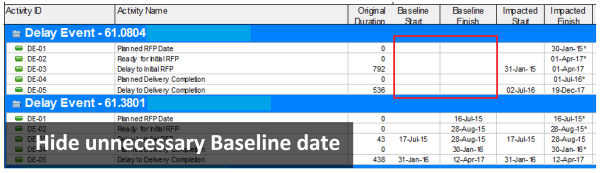
When performing delay analysis in Primavera P6, it’s common to compare the Impacted Schedule with the Baseline Schedule. However, displaying baseline dates in the Delay Event project can be misleading and unnecessary, as they do not represent meaningful data in that context. By default, Primavera P6 displays values in the Baseline Start and Baseline Finish... Continue Reading →
Impacted As-Planned Delay Analysis : Using Primavera P6 to see combined / consolidated effect from some or all delay events
Analyzing Combined Delay Events in Primavera P6 Without Creating Multiple Projects In a typical delay analysis scenario, suppose a project experiences five distinct delay events. If we want to analyze the combined impact of Delay Event 1 and Delay Event 2, we traditionally create a new project that includes only those two events. Then, to... Continue Reading →
How to perform Impacted As-Planned Delay Analysis in Primavera P6
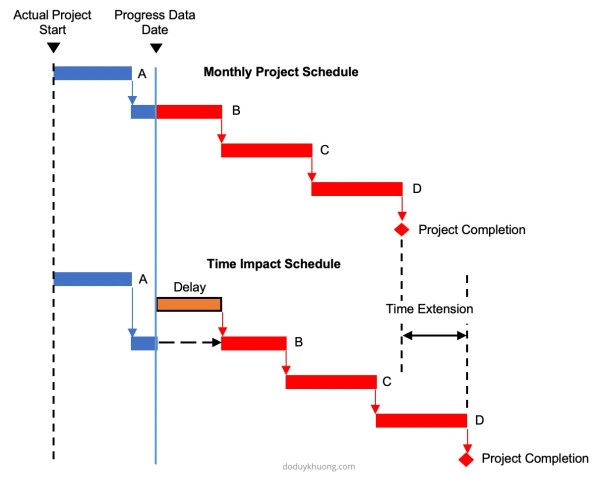
The Impacted As-Planned method measures the impact of the delays on the as-planned schedule. The delays are formulated as activities and added to the as-planned schedule showing the effect of each delay and demonstrating how the project is being delayed. The amount of delay equals the difference in completion dates between the schedules before and after the impacts. Step-by-Step Guide:... Continue Reading →

You must be logged in to post a comment.