When you need to quickly update a project in Primavera P6 (assuming everything is going as planned), there are two options for automatically applying progress: Apply Actuals Update Progress (Progress Spotlight) Both options update activities automatically, but they work differently. Let’s explore. Apply Actuals The Apply Actuals function updates activities that have the Auto Compute... Continue Reading →
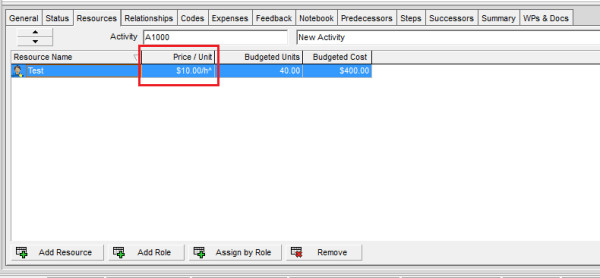
What does The Carat (^) Symbol next to the Resource Price/Unit in Primavera P6 mean?
When assigning a resource to an activity in Primavera P6, you may sometimes notice a carat (^) symbol next to the Price/Unit value. What does this mean? Let’s break it down. Reason for the Carat (^) The carat symbol indicates that the resource does not have a defined Price/Unit at the resource level. In this... Continue Reading →
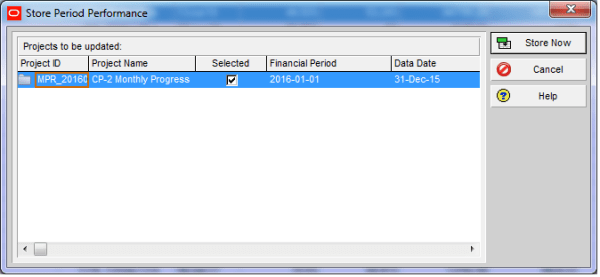
When do we use “Store Period Performance” function?
What Does Store Period Performance Do Using the Store Period Performance feature, you can track actual units and costs to date each time the schedule is updated. For example, if you increase the actual this period by 50, the Project Management module increases the Actual to Date by the same amount. At the end of... Continue Reading →
Turn off Auto Compute Actuals for 1 activity
By default, most Primavera P6 projects enable the option: “Recalculate Actual Units and Cost when Duration % Complete changes.” With this setting turned on, whenever you update Duration % Complete, P6 automatically recalculates and updates the Actual Units. This is useful in many cases, as it keeps progress and resource usage aligned. In some situations,... Continue Reading →
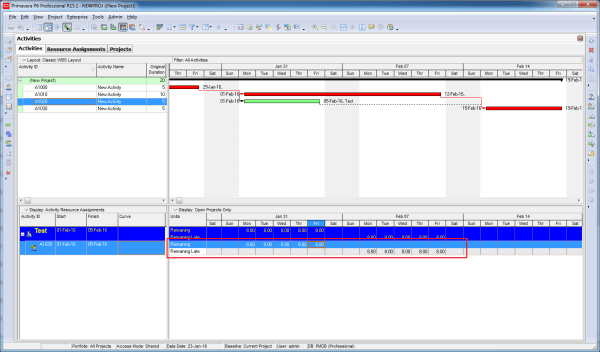
Does Resource Curve affect Remaining Late Unit
It is well known that applying a resource curve affects the Remaining Early Units. But what about the Remaining Late Units?The answer is: yes, they are affected as well. In the Resource Assignment window, both Remaining Early Units and Remaining Late Units are displayed. When a resource curve is applied, it does not only influence... Continue Reading →
How does “Resource curve” work?
Let’s assume we have an activity with a duration of 100 days and 100 labor units.By default, the resource distribution follows a linear spread. This means that the resources are distributed evenly over time.For example: At 5% of the duration (Day 5), you will have used 5% of the total units (5 units). The resource... Continue Reading →
How does “Actual units” spread when you use Resource curve
We have an activity which is applied "Back Loaded" resource curve. When we update the progress, the actual units are distributed in the same pattern as planned.This means that even during progress updates, the resource allocation follows the back-loaded shape, more resources are consumed toward the later part of the activity rather than at the... Continue Reading →

You must be logged in to post a comment.