Oracle has just released Primavera P6 18.8 and here's a look at what's new in Primavera P6 Professional version 18.8: Performance Percent Complete Field Based On Labor Units. The Performance % Complete - Labor Units field shows the percentage of the activity or project planned work that is currently complete as measured by labor units.Calculated as Earned Value Labor Units divided... Continue Reading →
Primavera P6 error when import Microsoft Project XML / Run Update Baseline, Claim Digger
When we import Microsoft Project XML file to Primavera P6 / Run Update Baseline / Claim Digger, an error could appear with Event code: CNFFC- Message: Could not find file \bin\java.exe. Cause: These are scenarios which can cause above error: There is no java.exe file in the \Primavera Common\]ava\jvm\bin directory The JAVA_HOME variable is set to... Continue Reading →
Benefit of using Primavera P6 in Delay Analysis
Primavera P6 is a powerful tool for conducting delay analysis in project management. It offers several features that help identify, evaluate, and present the impact of delays on project schedule. Below are some of the key benefits: 1. Identifying Activities That Impact Critical Milestones In complex projects, multiple delay events may occur, each affecting different... Continue Reading →
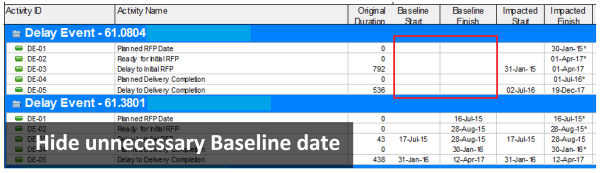
Delay Analysis report in Primavera P6: Hide Baseline dates in Delay Event project
When performing delay analysis in Primavera P6, it’s common to compare the Impacted Schedule with the Baseline Schedule. However, displaying baseline dates in the Delay Event project can be misleading and unnecessary, as they do not represent meaningful data in that context. By default, Primavera P6 displays values in the Baseline Start and Baseline Finish... Continue Reading →
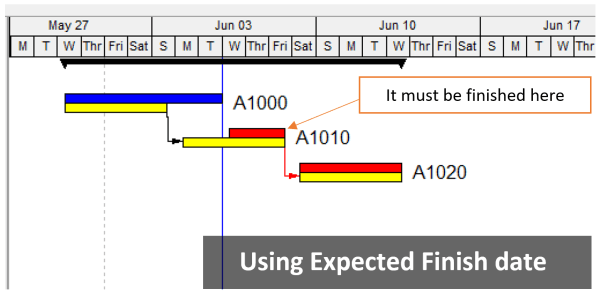
What is Expected Finish Date in Primavera P6 used for?
When scheduling a project in Primavera P6, you might notice that the Original Duration of an activity changes unexpectedly. This often happens when the Expected Finish Date is being used. What Is the Expected Finish Date? The Expected Finish Date acts like a constraint in Primavera P6—but only if the scheduling option “Use Expected Finish Dates” is enabled in your project settings. This... Continue Reading →
Primavera P6 SQL Server database slow loading data, performance issue
When using Primavera P6 with Microsoft SQL Server database, we can have problem like this: Loading Data hangs at 98%. Performance issues in SQL Server. Opening projects is slow. PM.exe not responding after entering username and password. Project Management window disappears after loading data. Cannot login to PM, no error. Here is the solution to... Continue Reading →
Primavera P6 export to Excel. How to color WBS level automatically
When exporting the Activity Table from Primavera P6 to Excel, it can be difficult to visually distinguish between different WBS (Work Breakdown Structure) levels. In this guide, I’ll show you how to automatically color-code WBS levels in Excel, making your report easier to read—similar to how it appears in P6. Step 1: Add the WBS... Continue Reading →
Primavera P6 export to Excel. How to identify WBS level for activity
After exporting the activity table from Primavera P6 to Excel, it's very hard to identity the level of the WBS structure. The activity table without WBS level information This article describes how to identify the WBS level. The first step is to add one column to show the WBS level and enter the following formula... Continue Reading →
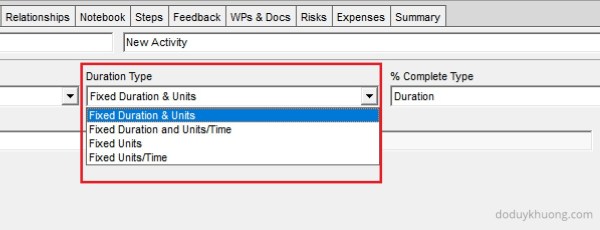
How to use Activity Duration Type in Primavera P6
When assigning a resource to an activity in Primavera P6, the following equation always holds true: Original Duration × Units/Time = Total Units For example:10 days × 8 hours/day = 80 hours This equation is fundamental and must always remain valid, regardless of changes made to the activity. When you modify the duration of an... Continue Reading →
What is the difference between Activity type: Task Dependent and Resource Dependent in Primavera P6
In Primavera P6, there are two commonly used activity types: Task Dependent and Resource Dependent. The key difference between them lies in how the software determines the calendar used to calculate the activity’s finish date. Task Dependent: P6 uses the Activity Calendar to calculate the finish date. Resource Dependent: P6 uses the Resource Calendar to calculate the finish date. This choice directly impacts... Continue Reading →
What is the difference between Total Float and Free Float in Primavera P6
In Primavera P6, there are two key scheduling concepts: Total Float and Free Float. While they may seem similar, they serve different purposes. Total Float:The amount of time an activity can be delayed without delaying the project’s finish date. Free Float:The amount of time an activity can be delayed without delaying the start of its immediate successor.... Continue Reading →
Impacted As-Planned Delay Analysis : Using Primavera P6 to see combined / consolidated effect from some or all delay events
Analyzing Combined Delay Events in Primavera P6 Without Creating Multiple Projects In a typical delay analysis scenario, suppose a project experiences five distinct delay events. If we want to analyze the combined impact of Delay Event 1 and Delay Event 2, we traditionally create a new project that includes only those two events. Then, to... Continue Reading →

You must be logged in to post a comment.